


The Rule Of Democracy 1905-1914
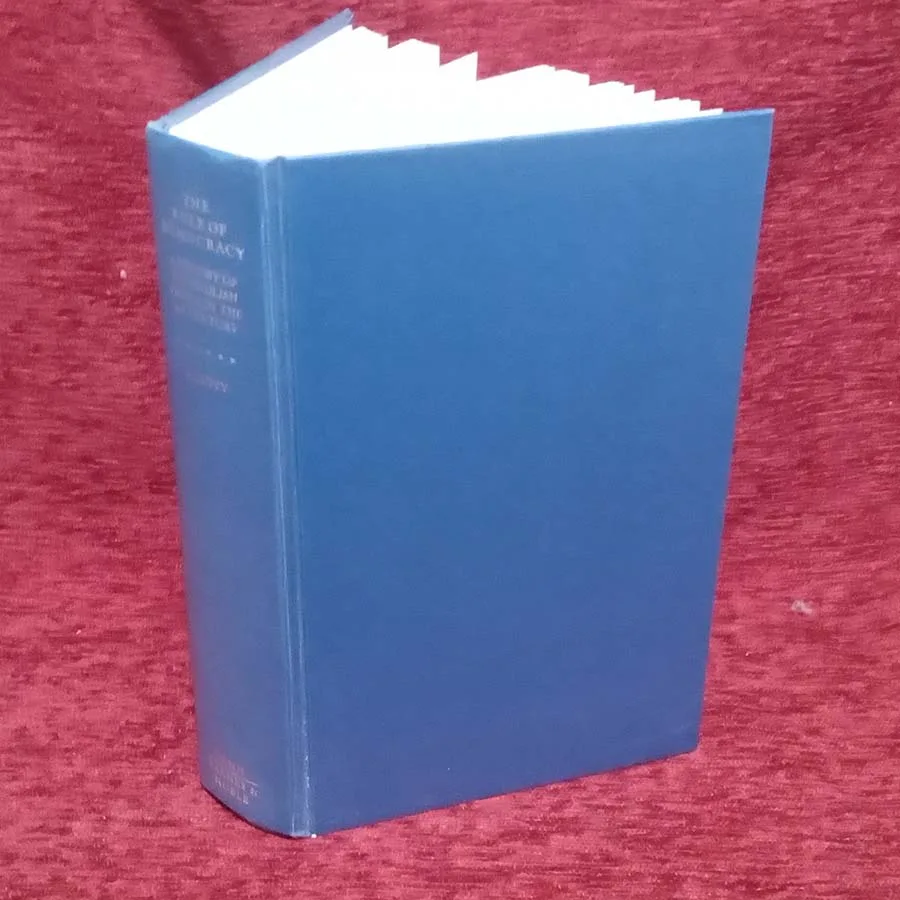
Publisher: Ernest Benn Limited
Format: Hardback
ISBN: none
Ah, The Rule of Democracy 1905–1914 (1968) by Elie Halévy—a book that bravely attempts to explain that curious historical moment when democracy was confidently marching forward… right up to the edge of one of the least democratic events imaginable.
Halévy, with the calm authority of a man surveying a neatly arranged catastrophe, explores the years just before the First World War, when Britain (and indeed much of Europe) appeared to be settling into a sensible rhythm of reform, representation, and parliamentary debate. It was, on paper, a triumph: expanding suffrage, social legislation, political parties behaving more or less like political parties. Everything was becoming modern, orderly, and reassuringly rational—precisely the sort of stability that history has a habit of abruptly interrupting.
What makes this volume quietly fascinating is its tone. Written with scholarly composure and a certain understated elegance, it treats the pre-war years as a kind of slow, methodical build-up—an era in which democracy was not only functioning but refining itself. One almost gets the sense that if everyone had just carried on discussing matters politely in Westminster, the twentieth century might have turned out rather differently. Alas, history had other plans.
This 1968 edition carries that distinctly mid-century confidence in the ability to analyse, categorise, and ultimately understand the past. Halévy guides the reader through political reforms, social tensions, and the delicate balancing act of governance with the assurance that everything can be made coherent if one looks closely enough—though the looming knowledge of what comes next adds a faint, ironic tension to every page.
Condition-wise, this copy is in good order, meaning it has likely been handled by previous readers attempting to make sense of Edwardian politics and perhaps quietly wondering how it all managed to go so spectacularly wrong. Expect the usual signs of age consistent with a book that has outlived the certainties it describes, but remains perfectly readable and, indeed, rather dignified in its survival.
In short, this is a thoughtful, measured, and faintly ironic account of democracy at its most self-assured—just before the world decided to test that assurance in the most dramatic way possible. Ideal for readers who enjoy history with a sense of impending irony, and for anyone curious about how stability, once achieved, can prove so remarkably temporary.
Keep browsing: See more History books Other books by Elie Halevy
